12
The Single Silo University
Gordon Fletcher, Richard Dron and Mònica Dalmau Gimeno
Gordon Fletcher¹, Richard Dron¹and Mònica Dalmau Gimeno²
¹University of Salford, Salford, UK
²Independent Scholar, Barcelona, Spain
g.fletcher@salford.ac.uk
r.dron@salford.ac.uk
Creating a single priority: The university strategic plan
The University of Salford has always played a significant role in the development
of the local community through its economic contribution and social impact. It has
worked closely with industry and public sectors through enterprise and research
since at least the launch of the Enterprise in Higher Education initiative in 1987.
There has also been ongoing recognition of the need to maximise national and
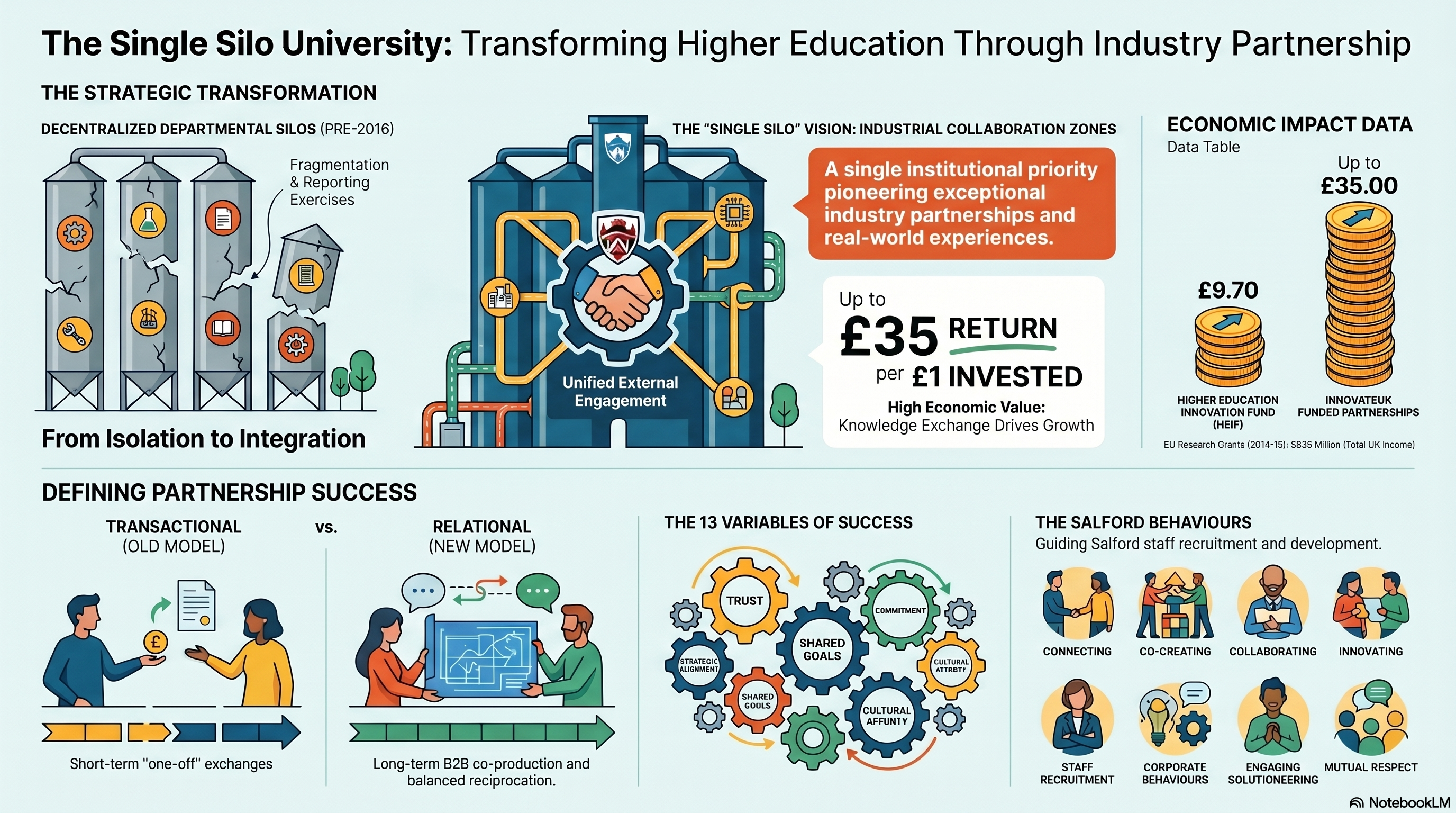
international business partnering. Until 2016, this partnering activity was largely
departmentalised within the University level research administration services. This
meant that partnerships generated by academics with external organisation were
largely managed as a reporting exercise rather than being actively planned,
encouraged or managed. While there was some recognition of partnering activity in
the plans of each academic school the result of this organisational treatment of
partnering was a tendency was to see this work occur in isolation and as a separate
silo of activity removed from other research or teaching and learning. Some
academics were regarded in a colloquial sense as being ‘good’ at partnering
without clear explanation or comparison against recognisable benchmarks. With
the University’s 2016–2021 strategic plan, a series of “Industrial Collaboration
Zones” were formed that made business partnering the sole strategic institutional
priority. In practice, the plan created four focus points for collaboration that cut
across existing organisational structures and divisions and actively worked to reach
out and engage external partners. In the lead up to the development of this plan, the
University had been in a process of continuously evolving its internal structures
from a multi-layered hierarchy of faculties that were composed of many small and
managerially independent schools to the current configuration of four large
academic schools representing health and society, arts and media, science and
engineering and business. Within these schools is an solely internal structure of
departments that vary in size from ten to 50 academics of broadly connected
disciplinary interests. This final configuration was itself triggered by the
University’s 2016-2021 strategy and, in part, recognising the often confusing
structures that confronted potential students and businesses wanting to engage with
the University.
The rationale for taking this approach was well-evidenced from an economic
and policy point of view. The association of higher education with ‘employability’
191
Excellence in University Leadership and Management
and the need for UK universities to support the recognised skills gap were all
emerging agendas at the point of the strategy’s formulation. Collaborative external
partnerships make a significant contribution to most UK universities. The
University’s new strategic vision reiterated this understanding with a clear
statement regarding its expectation regarding the use and value of partnerships
(University of Salford, 2016a). At the level of organisational culture and situation,
the University’s choice of direction also reflected an opportunity to differentiate
itself from institutions located nearby. The strategy also gave a voice to a prevalent
internal perception that there was always something ‘different’ about the institution
that was often ‘lost’ with external audiences. Despite the merits of the strategic
direction, at the same time the strategic vision raised a series of questions that
required operational actions to be successfully realised (Table 1).
Table 1: The university vision statement and the questions that it raises
Strategic vision “ pioneering exceptional industry partnership [1] we will lead the way
in real world experiences [2] preparing students for life [3] ”
Desired • Create, foster, and maintain partnerships
operational
• Create or access real world experiences
actions
• Aligning delivery with partners and ’ expectations
and needs
Questions • What is an exceptional industry partnership?
• What defines an exceptional industry partnership?
• How can exceptional industry partnerships be measured?
• What does a real-world experience look like?
• What are the benefits to the student and the partner?
This strategic vision statement could be interpreted broadly and in varying contexts
by different parts of university. And this variety of interpretation did invariably
occur. The academic contexts created by different disciplines, the variability of
forms that partnering activities can take and the highly distributed nature of
professional responsibilities in universities are all a major challenge to creating an
effective partnering ecosystem within universities.
The popularity of matrix management lines also presents a clear challenge to
ensuring that operational requirements and departments can align and work
together with a shared purpose to achieve the intent of the strategic plan. Many
universities have evolved matrix forms of management with an associate dean
taking a lead around a portfolio such as research or engagement while heads of
department (or similar) are directly responsible for managing people. The strategy
and its priority did not set out to restructure this existing matrix. Instead, as a
mechanism to gain grassroots support the university team tasked with
operationalising the strategy sought out colleagues who regularly engaged external
organisations but did not already have formal roles (such as Associate Dean) to
become thought leaders. This was done without any systematic assessment of the
192
Gordon Fletcher, Richard Dron and Mònica Dalmau Gimeno
individual colleagues but rather achieved through referrals from multiple trusted
colleagues so that the thoughts leaders were ‘generally regarded as good’. The
result of this loose process was to identify individuals scattered across the schools,
located within the existing matrix of management, with a brief to be daring and to
win hearts and minds. The University undertook an external recruitment process to
discover portfolio leads who were given a role that was a mix of being disruptor,
change agent and aspirational role model. In some cases, internal applicants – from
among thought leaders – were recruited to this wider role that was detached from
the traditional management structure. Portfolio leaders did have priorities and these
were largely shaped by the external environment and strategies that deliver results
in the context of one or other “excellence framework.” In contrast to the role of
portfolio leader, the existing role of departmental head is more commonly focused
on immediate operational needs and, in the worst situations, their activities
concentrate on reactively “keeping the wheels on.” It was often in the space of
departmental management and the existing challenges of delivering existing
services effectively and efficiently where the most resistance to the new strategy
emerged. As a result of this tension there was a genuine need for a collective
preparedness that committed to the overall institutional strategy as a mechanism
for change. This preparedness coupled closely with a need for high levels of trust
in that university leadership to enable a strategy that could be regarded, by some,
as not directly related to their own portfolio of concerns.
Internal resistance to this single silo strategy inevitably did occur and was
evident from the first formal announcements of the strategy. The forms of
resistance represented a broad arc ranging from claims that this represented
“business as usual” for some groups of colleagues (so there was no need to change)
through to the argument that the strategy diverted focus from teaching and learning
activities with an implication that the purpose and focus of the strategy was
incorrect. A key tension for many staff was the strategy’s focus on business
partnering and its emphasis on being the single priority for the entire institution.
Having such a singularity of purpose in the statement was a significant change and
challenge for many on a conceptual level as it was about the specifics of the
strategy. A focus on business partnering was also challenging for many others who
questioned the relevance to their own practice, their discipline or the assumed
direction of travel that their own academic department was pursuing. All of these
critiques reflected an organisation that was uncomfortable with strategic planning,
long-term commitment to a single plan and reflected a challenge to the flourishing
small-scale “kitchen table” activities that were flourishing and leading in multiple
different priorities across all academic departments. As a result of these pushbacks
from staff there was significant internal engagement work undertaken throughout
the first year of the strategy to acclimatise its purpose and benefits across the
university community. As forums for discussion the critical unpacking of the
vision (Table 1) was rehearsed through each staff meeting. The need for well-
designed parameters to measure partnerships in a consistent way across different
forms and disciplines also soon became very evident as a result of these meetings.
193
Excellence in University Leadership and Management
Theorising partnering
Genuinely understanding and theorising partnering became a core aspect of the
strategy’s development. As the strategy became embedded within the
organisational culture, the internal understanding of partnerships proved to be
highly variable. This variability was revealed with the presentation from different
departments of their “good” partnerships. The effect of this sharing was a
showcase of partnerships that went from little more than one-to-one email
exchanges though to the much rarer form that incorporated complex multiple
streams of activities that extended across teaching and research. Creating an
institution-wide baseline for an exceptional partnership required its own stream of
research in order to disseminate a shared comparable understanding of ‘good’ as
well as setting out a series of achievable aspirational activities that could enhance
existing partnerships.
There is a direct positive correlation between university activities and overall
prosperity in the economy. Creating and applying new knowledge is a primary
factor in driving economic growth. Universities are one of the key incubation sites
for the creation and application of new knowledge. This is particularly true in areas
of domain knowledge where research and development time as well as money is
scarce in other organisations. The sense among some academics that Salford’s
strategy was a continuation of their current practice was clustered in specific
disciplines (and consequently departments) for this reason.
Partnering opportunities enable commercial organisations to leverage
universities as growth partners, to bring continuous improvement to the business
and to advance their sustainability at local, regional and national levels. Salford’s
ongoing success, comparative to its size, in many of its departments with the
government-funded Knowledge Transfer Partnership scheme gave substance to the
internal sense among colleagues of an organisational difference that was often
understated publicly.
The need for collaboration between industry, academia, and government has
been further emphasised with growing demand for the introduction of sustainable
practices in products such as cars and house construction as well as within the
urban environment. Equally, universities need to grow their industry connections to
offer students experiences that let them implement theoretical knowledge to solve
real industry problems before they enter employment. The model of the Triple
Helix is the most commonly utilised work to understand these interlinking needs
between universities and other organisations. However, previous theoretical
positions invariably do little to define what a good partnership looks like in form
and instead focus on the position that partnerships themselves are good and should
be part of all university ecosystems. Knowledge of this legacy of academic
literature associated with the strategy was concentrated within business academics.
This created a situation in which some business academics were resistant to the
purpose of the strategy because they ‘knew’ the literature (and were critical of the
work on an intellectual level) while other academics regarded partnership as a
more organic process (or simply one driven by their personal networking) and were
resistant to more systematic and institution-level interventions.
194
Gordon Fletcher, Richard Dron and Mònica Dalmau Gimeno
Theories of relationship management drill further into notions of what makes a
good partnership and have evolved to consider a wide range of working
environments including universities. Relationship management’s focus upon the
activities that establish, develop, and maintain successful relational exchanges
presents a fruitful level of thinking to define an institution’s own quality baseline.
Moreover recently, the significance of relationships over and above transactional
exchanges has become increasingly important in all types of organisations and
relationship management considers how customers can produce and co-produce
ongoing value in contrast to individual or discrete transactions. This emphasis
implies the need for longer-term and high-quality relationships in practice. Because
previous institutional practice had often focused on the reporting of partnerships
that had generated by academics the significant difference between transactional
contacts and more embedded relationships had been left poorly acknowledged. For
some academics having any type of contact that could be labelled as a partnership
was regarded as positive. Depending on practice within schools and departments,
claiming the existence of partnership may even have produced a small allocation of
workload without deeper scrutiny of what activities were occurring or the
opportunities that may have been left unrealised when the linkage remained as one
academic to one individual in the partner.
There are three identifiable approaches to relationship management. The
Nordic School concerns itself with the interaction between consumers and
marketing functions and uses descriptions such as “buyer-seller interaction”,
“interactive marketing” or “customer relationship” to reflect the focus. The second,
Industrial Marketing and Purchasing Group (IMP), approach is based on
interaction and networking approaches to business relationships and emphasises a
view where transactions are not seen as isolated occurrences but as part of a set of
continuous ongoing engagements. Finally, the Anglo-Australian school places
value on the integrating concepts of quality management, service marketing, and
customer relationship economics.
The complex challenges associated with business-university partnering is
conveyed at the intersections of these three schools of thought. As a result, the
influence of all three schools of relationship management is evident in the ways
that universities generally undertake their partnering. The size mismatch between
universities and the businesses they are endeavouring to partner with, especially
SMEs, can unwittingly move the relationship towards becoming a series of one-to-
many B2C transactions - and all the issues that this implies. To be successful the
partnering needs to be long term and continuous, even if it fluctuates in its intensity
significantly during the partnership. This makes the relationship more B2B in form
and more accurately reflecting the way the partnership should be viewed. The
contrast of these two models also reveals the conceptual tension between having a
partnership with the university as a single entity and the contrast with day-to-day
reality where interactions are conducted on an individual level.
Examination of the practical experience of partnering between businesses and
the University revealed a pivotal quality for all of the successful relationships
which was the importance of balanced reciprocation. The existing partnerships
revealed that those most easily quantified as successful brought benefits to both
parties of similar value even if the form of that value differed. Relationship
195
Excellence in University Leadership and Management
management also acknowledges the role of trust, commitment, and satisfaction as
being key to developing a successful sustainable organisational relationship. In the
University of Salford, these attributes had to be achievable internally first given the
need for departments as well as staff and students to work together before external
relationships could be maintained successfully. The blend of relationship
management perspectives used in universities and the complex internal/external
interaction reflects the complex three-way partnering relationship that exists at an
operational level between academics, students, and businesses. In the complex
partnering relationship it was often evident that personally managed partnerships
were often made simpler by dropping, or reducing, the student input and
opportunities. These short-term simplifications also evidenced a consequent
longer-term diminishment of the value of the overall partnership. For the
businesses, access to students (and potential graduate employees) was almost
always part of the reciprocal benefit.
Beyond the challenges of creating an internal environment of trust and
commitment came a further complexity that related more clearly to the student
experience of partnership. With students coming from a range of backgrounds and
different countries a further factor for successful business relationship development
can be seen in the need for cultural affinity, diversity, and experience. The need for
this understanding becomes a more significant in international contexts precisely
because of their increased psychic distance.
The partnering challenge is even more complex with at least thirteen
recognisable variables for partnering success: commitment, cooperation,
interdependence, comparison level of the alternative, non-retrievable investments,
summative constructs, social bonds, trust, mutual goals, performance satisfaction,
adaptation, shared technology, and structural bonds. Even with the definition of
this wider set of key variables there remains a need to recognise that any set of
variables related to partnering are contextual and modified by the specific situation.
Examining specific examples of partnerships within the University made it clear
that not all the variables needed to be fully present in a positive sense to be
considered successful. Even with the variables defined there are multiple patterns
of success and no “one size fits all” partnership model. The challenge for the
strategy and its objectives was that portfolio leaders regularly reported this need for
sensitivity to context. However, as a change programme the need for context was
sometimes applied as a mask to justify legacy partnerships that offered scant
evidence for success through any combination of the thirteen variables. It was also
evident from these variables identified that there were indicative patterns more
relevant to universities and for gaining the type of benefits that universities were
seeking from their partnerships. In a higher education context, the value of
business partnership comes from generating innovative classroom practice, gaining
access to primary research data and income generation opportunities. The portfolio
leaders, as a set of eyes that were generally more independent and detached from
the institutional legacy were particularly conscious of these variables and their own
performance objectives were shaped by these beneficial activities. Being new, or at
least new to the role, also enabled the portfolio leaders to re-evaluate the benefits
of existing partnerships without the fog of unsubstantiated claims and with a
mechanism for an assessment that could be justified. This undertaking was not
196
Gordon Fletcher, Richard Dron and Mònica Dalmau Gimeno
solely a case of removing poor partnerships. With the thirteen variables and
acknowledge the contextually different weighting of each provided leaders with a
way to make constructive and supportive suggestions for improving existing
partnerships and make them more valuable. Identifying the variables for successful
partnership also defines behaviours that are valuable within a university
environment more generally. One indirect outcome of the strategy has been the
development of ten Salford Behaviours that are now incorporated into staff
development activities, the management development programme and workshops
that define the vision of the schools, the departments, and the courses. These
behaviours are expressed with a single word. The influence of the strategy is
particularly evident with behaviours such as ‘connecting’, ‘co-creating’,
‘enabling’, ‘inspiring’ and ‘learning’. This development has continued to develop
the institution’s collective and shared awareness of itself not only in relation to
partnership with businesses and industry collaboration but more widely with all
knowledge exchange activities (in the widest possible meaning of this term). This
develop is a justification, in itself, for adopting a single silo university strategy but
the set of variables also reveal the ways that theorisations of relationship
management and partnering are the most well-defined forms of knowledge
exchange practice.
The value of knowledge exchange
Although university and industry activities are interlinked it is difficult to directly
evidence the total value of commercial knowledge exchange. However, some clear
indicators of the financial value generated shows the scale of its impact within the
economy. In 2014–2015 more than £836 million in research grants and contracts
from the EU were provided to UK universities amounting to 14.2 percent of the
UK’s research income. The creation of economic value is also shown in the claim
that the Higher Education Innovation Fund (HEIF) generates £9.70 to the economy
from every £1 invested. The outcome from InnovateUK funded partnerships can
return up to £35 back to the economy for every pound invested. Universities are
crucial to the evolution of national industry and economy, as they have the
flexibility to take advantage of new opportunities and provide rapid responses to
new needs that emerge from industry challenges.There are some indications that
there is increasing recognition of the benefits that university partnering can bring
with a continuously increasing number of knowledge exchange activities between
UK universities and public, private, and third sector organisations.
Notwithstanding the acknowledged contextual and situational nature of
partnering the university strategy still needed to understand impact in ways that
could be measured and compared. Irrespective of the form of measurement,
business to business relationships are understood within a current dominant logic
of a service-centred economy that positions service provision as fundamental to
sustainable economic exchange. At the core of this logic is the importance of
collaborations and partnerships above the supply and sale of goods or products.
Despite the differences between universities and traditional commercial
organisations this key point is central to any measurement.
With the service-centric perspective and the need to understand the
University’s partnerships in a comparative and consistent manner the need to
197
Excellence in University Leadership and Management
measure became evident. Utilising the thirteen variables of successful partnering
became the basis for this activity. Data was captured from twenty existing
partnerships based around the thirteen variables and tentative bandings were
defined (with acknowledgement of the relatively small sample being used). Using
visualisations of the data and to create an iterative process this work was shared
back with the academic leading each partnership to understand the value of the
bandings and better insight as to the value and meaning of the variables within
each partnership. A key learning from these iterations was that bandings were
sometimes overly nuanced and within some partnerships specific variables were
more often binary choices. Key contextual differences were also identified through
this process specifically the noticeable differences between SMEs and larger
enterprises in terms of the values that created success and the more granular
differences between sectors which was hampered by small sample sizes and an
institutional bias to partnerships in a relatively small range of sectors.
As knowledge is of central importance and value to universities consideration
of “absorptive capacity” is also relevant in the consideration of partnership success
and impact. This perspective aligns closely with dominant service-centred logic
where value is based on the application and exchange of knowledge and skills
rather than assumed to be embedded within tangible resources or goods. People
exchange knowledge and skills to acquire the benefit of specialised competencies
or services. In universities this is expressed as a need to create reciprocal
relationships that are able to mutually create and exchange knowledge. The
formation of these types of partnerships are then best able to respond to an
increasingly volatile, uncertain, complex and ambiguous external environment.
Unpicking the theorisation of what constitutes a “good” partnership in a knowledge
organisation - including a university - produces a key learning from the single silo
strategy. Knowledge exchange defines all the key activities of a university and the
matrix of associate dean portfolios generally resolve to represent specific forms of
knowledge exchange activity. This is a challenging statement for many individuals
within a university. When we took our observations to key stakeholders within the
university who were charged with the management of teaching and learning,
creating international partnerships with other universities as well as research there
was a very mixed response. These areas of the University’s operations sat outside
the academic school structure where most attention had been applied in the
operationalisation of the strategy. These functions were embedded within the
University’s professional services structures that had in some cases less willing to
recognise the value or purpose of the strategy within their own current practice or
purpose. In effect, a siloed response to the strategy had been developed in these
departments that suited existing internal needs and structures and represented less
disruptive or radical responses than were made possible by the strategy. There was
general acknowledgement that in principle the conclusion was correct, but
individuals and groups effectively acted as gatekeepers for maintaining practice
with a lighter touch acknowledgement of the purpose of the strategy. When pushed
on how the management of their own functions within the university might change
considering a knowledge exchange perspective the reaction was often less positive.
It became very clear that the ambition of the strategy would need to evolve further
to elicit change more broadly. The legacy of information systems and of work roles
198
Gordon Fletcher, Richard Dron and Mònica Dalmau Gimeno
largely defined around functions that would be directly challenged by altered
perspectives was too much of a management challenge with too little prospect of
additional benefit to be justified of the risk. With the conclusion of the five-year
strategy in 2021 there is now evidence of organisational change within the
University that now does reflect the knowledge exchange perspective. This has
included the promotion of the ten Salford Behaviours, the formulation of an
Innovation Strategy to replace separate engagement and research strategies and the
ongoing re-organisation of many professional service departments. All of these
actions reflect a conscious movement towards a service-centred business logic
across the University. Reflecting the experience during the period of the strategy,
this has met resistance from some parts of the University. The overall programme
of change now underway in the University has been influenced by the outcomes of
the 2016-2021 strategy as well as the national introduction of the Teaching
Excellence Framework and Knowledge Exchange Framework and more recent
changes in the higher education and Office for Student policy with the proposed
Proceed metric.
Working with partners requires the mutual agreement to share benefits and
mitigate risks. Individual enterprises increasingly no longer work as independent
entities but through collaborative networks and clusters. The advantage of this type
of working is in direct contrast to a persistent perspective in higher education
environments where some academics cast themselves in the role of being an
independent contractor reactively responding to requests for work activity from
management as and when required. This attitude, combined with the increasing
casualisation of the workforce through the use of adjunct faculty makes pro-active
collaborative working more difficult to successfully achieve. A networking
philosophy encourages collaborative working to achieve mutually beneficial goals
where the parties become partners but it is problematic for individual academics
who resist the transparency (and opportunities) of sharing culture. We encountered
this directly with the evaluation of partnerships in the university as some
partnership “owners” actively resisted our enquiries as they were particularly
concerned about someone “stealing” “their” partnership. This was the cultural
change that the strategy needed to engender when transactional modes of thinking
are transformed into collaborative models. It should be stressed that the change in
thinking required was often more about internal perspectives of the different
departments than the external partners. Bringing about this change in
organisational thinking has, in turn, produced an evolution in relationship
management perspectives. Moving away from dominant individualistic concepts
such as competitive advantage in favour of social and communal terms like
collaborative advantage echoes both the individual as well as theoretical
transformation that has had to occur. The partner is seen as the co-producer and an
active participant in the relational exchange as well as a co-creator of value. The
small value produced in a short-term exchange transaction becomes secondary to
long-term value co-creation that is the product of collaborations across multiple
stakeholders. Although commercial organisations increasingly recognise the
central benefits of a knowledge based approach to partnering there is a clear lag in
recognising the value of applying this perspective to university practice.
199
Excellence in University Leadership and Management
Thinking regarding value creation and knowledge exchange primarily comes
from observation of traditional “for-profit” commercial organisations found in
existing literature. However, increased scrutiny of UK universities through the
“excellence frameworks”, their wider social and economic impact, internal funding
challenges, and their pronounced role as knowledge producers the conclusions of
this wider body of literature increasingly works for universities too. The
“knowledge economy” through the creation and application of knowledge is a
primary factor in driving economic growth. This knowledge economy is driven by
industry, academia, and the government working together in response to market
demands for skilled labour and innovation.
Parameters for a successful partnership
With an understanding of the significance of partnerships and taking the viewpoint
that long-term knowledge exchange orientated collaborations produce greater value
than transactional relationships leads to the need to determine the factors that
enable university-business partnerships to be considered as successful.
Earlier literature identified many factors for successful business partnering.
Some classifications are shaped negatively around concepts such as time restraints,
lack of unity, communication difficulties or poor management. Others present the
success factors in a more positive frame highlighting the value of trust,
communications, diversity, and a culture of learning. Although the approaches
vary, there is general agreement that the responsibility for managing business
relationships rests with both parties. The variety of views in the literature were
represented within the University by different attitudes towards partnerships and
their overall value. The most enthusiastic saw the value of partnerships in
everything they did with opportunities across the entire spectrum of university
activities. Some colleagues regarded a partnership as a lower order priority than
classroom activities or even a barrier to getting on with ‘real’ research. More
worrying some colleagues lacked any opinion and were willing to let others
collaborate while they repeated already well-rehearsed routines in their work
practice. These latter positions are present irrespective of the clear value that
partnering brings to classroom and research.
However, some of the frustrations expressed by less enthusiastic colleagues
may have had some justification from the available evidence. Examination of the
many claimed institutional partnerships often revealed a lack of any real
management in the relationship process. Making maintaining the relationship
problematic at the very least. Without clear reciprocal management in many of the
University’s partnerships other factors could also be identified as falling short of
optimal. A main factor for long-term success is the definition of goals that set out
complementary and clear objectives for the partnership. Goals assist in framing the
collaboration’s value as a whole and the responsibilities of each partner. Having
agreed purpose brings alignment between the mission and vision of both partners.
Other operational factors enable a reciprocal alignment but most important is the
level of project management that brings coordination of the relationship while also
enabling flexibility for both parties. The value of shared goals, coordination, and
shared understanding of the relationship are central to all strong partnerships.
200
Gordon Fletcher, Richard Dron and Mònica Dalmau Gimeno
The presence of trust is crucial in the early development phases of a
relationship. The importance of this in university-industry partnerships is pivotal to
long-term success and setting expectations. The formal project plan and the
collaborative creation of the application documents used in Knowledge Transfer
Partnerships is one example of how to build trust early, set expectations for both
parties clearly and build a working relationship quickly. Higher levels of
commitment — put into a relationship early on by each partner — assumes a long-
term and sustainable situation. Mutually sharing the expectations of both partners
early on and in a transparent way also helped to remove any doubt as to why
everyone is involved.
However, with knowledge of the importance of trust in a partnership, efforts to
capture the parameters for successful partnerships constantly showed the process to
derailed by the complex internal organisational environment. In effect, the
University’s various departments were found on a number of occasions to be in an
almost competitive relationship with one another for the attentions of the same
partner. This made the University’s purpose and expectations opaque and had a
negative impact on trust. In some cases, this resulted in the business partner
retreating to contact solely with the original academic or, in the worst case,
withdrawing completely. Qualities such as trust and commitment were often absent
between departments within the university, and this could increasingly be
identified as a major impediment to successful (external) partnering. Upon
investigation the root cause for this damaging situation often came back to the lack
of clear internal reciprocating relationships and a lack of trust founded in a shared
organisational vision – a legacy of the organisational culture that was prevalent
prior to the 2016-2021 strategy. The concern this recognition raised was
fundamental. If parts of the institution could not cooperate on partnering activities,
then the likelihood that research or teaching based collaboration could ever
eventuate would also be unlikely. Realising that the parameters for partnership
success were also measures for internal permeability and cooperation returned to
the persistent observation that all the core services of the University were forms of
knowledge exchange.
Much of the previous research regarding business relations focus on identifying
quantitative factors however more qualitative factors now also receive attention in
the conscious movement away from transactional perspectives. Geographic
location, the political climate, and social context are also viable considerations.
Irrespective of which factors are prioritised there is a clear interconnectedness
between each identified success factor. For example, outstanding communication,
good coordination, and multiple connections between parties are all components
present in an atmosphere of general success. It is also as important to have
agreements that evidence the formality of the relationship. All these factors build
trust and confidence in the relationship and enable further planning of future
actions. As they have overlapping interrelationships, success factors cannot be
understood separately but rather as a set of elements that in combination have a
bearing on the success of a business relationship. In this way the many parameters
for shaping a partnership are better considered as contributing to specific patterns
for success. There is not a single right approach, and contextual sensitivity ensures
that attempting to identify this type of framework would never realistic. However,
201
Excellence in University Leadership and Management
it is possible that the identified parameters can be combined in multiple different
ways to produce a successful partnership.
The existing literature reinforces the need to combine the success factors into
patterns that can produce success that is sensitive to locational and situational
context (Table 2). It was this set parameters that became the basis for evaluating
and comparing existing and emerging partnerships that we used within the
University. These parameters could be scored within quantitative bands and
visually graphed in a manner similar to the format used to report KEF outcomes.
To ensure alignment each parameter was also consider in relation to the most
relevant excellence framework, an indication of the quality that the parameter
brought to the partnership. Figure 1 indicates the scoring for the first parameter
‘Real World Experience’.
Table 2: "Parameter" and "Real World Experience"
Excellence Teaching
Framework
Qualities Demonstrability
Criteria Real world experience (internships, exchanges & work
placements)
Core (C) and % Work placements (L)
Leading (L)
University Indicators
Low (1) Students are unaware of the relationship with the organisation. No
student involvement in the collaboration.
Medium - Low (2) Generally students are unaware of the relationship with the
partner. Few and sporadic student involvements (<=1 student
p.a.).
Medium (3) Awareness of the partnership among students on specifically
related programmes. A small number of students are involved (<3
students p.a.).
Medium - High (4) Students within a few programmes or a School are generally
informed about the partnership. A number (<8 students p.a.) of
students are involved.
High (5) There is a university-wide awareness among students of the
partnership and the potential opportunities. Many students are
regularly involved with the partnership (<15 students p.a.).
Exceptional (6) Students University-wide are fully aware of the collaboration and
there is a clear route to easily become involved. There is some
possibility to be hired or receive an academic award from the
partner. Many students are regularly involved (>=15 students p.a.).
The visual representation also enabled visual comparison of the changes in the
partnership over time. The academic evidence for the value of each parameter
(Table 2) was an important aspect of the work as the intention was to convince
academics that all their partnerships could be captured and measured in this
consistent way. This graphical representation also allowed for direct comparisons
to be made across multiple partnerships. An example of a sports technology beacon
partnership (Figure 1) indicates the variables being used and how the banded
scoring was represented ranging from 1 (lowest) to 6 (highest). Figure 1 also
202
Gordon Fletcher, Richard Dron and Mònica Dalmau Gimeno
outlines in summary the other twelve parameters that were used alongside ‘Real
World Experience’ each had a similar rubric for assessment (Table 2).
Figure 1: Sport technology partnership visualisation
A key outcome from sharing these parameters for success with existing partnership
leads in the University was that more ambitious activities were planned by the
partnerships based on the parameters and the evaluation criteria listed for each. In
other words, ambitious partnership leads used the table of parameters as a type of
“shopping list” of potential new activities to explore with their partners. In some
rarer examples, the academic leading a partnership used the literature cited by the
sources used in the evaluation parameters (Table 3) as a form of further reading to
better understand the value of the parameter and the benefits to their own
partnership. The issue of a partner’s scale (Figure 1) in relation to the thinking
expressed in the previous literature became a source of ongoing debated for some
colleagues. This parameter was seen as biasing focus towards partnering with
multi-national corporations over SMEs or startups. Increasingly the debate evolved
the parameter itself to become consideration for a partner’s presence (both
physically and digitally). This viewpoint better aligns with locational context and
consideration – where high levels of presence might be important in a civic or
regional context – and also captures the understanding that a startup can obtain
very high levels of presence if their offering was disruptive or challenging
established sector leaders. This evolution also aligned more comfortably with the
thinking defined in the previous literature relating to communication and
environmental characteristics.
203
Excellence in University Leadership and Management
Table 3: Success parameters for business partnering based on existing literature
Parameter Description
Goal setting Common, complementary and clear objectives set across
partnerships. Goals established from the beginning of the
collaboration that clarify the importance of the relationship as well as
the potential benefits and risks that each party is taking (e.g.,
Jacobson & Ok Choi, 2008).
Coordination Excellent coordination brings flexibility and adaptability (e.g., Palmer
et al., 2005).
Nature of the Coherence of intention and motive surrounding the partnership leads
to a clear relationship between parties. Learning from the
relationship
collaboration must be available to both partners (e.g., Durr 2014).
Sustainability The level of engagement within the relationship and the commitment
to sustain it assumes that the relationship has a future, bringing value
and benefits for both parties (e.g., Williamson et al., 2016).
Communication The quality and process of information exchange between the
partners adds value to the relationship. Data sharing, open, and
frequent communication through formal and informal links are
important (e.g., Williamson et al., 2016).
Real evidence Early establishment of methods that measure both qualitative and
quantitative partnership impact (e.g. Ulrichsen & O’ a 2015).
(Inter)dependence Awareness that both parties are strong individually but benefit from
the value created by the partnership making both more successful. An
understanding by the partners that complementary skills produce the
greatest impact (e.g. Benson, 2016).
Environmental Contextual circumstances affect the success of a relationship
characteristics including geographic location, social context, political climate, or
government policy (e.g., Williamson et al., 2016).
Trust Reliability implies mutual respect and understanding of those in the
partnership (e.g., Williamson et al., 2016).
Multiple Having a broad range of connections between partners links the
connections organisations at many different levels and through multiple layers of
decision-making. This requires a multidisciplinary approach and
promotes cross-disciplinary projects (e.g., Edmondson et al., 2012).
Formal agreement Formal evidence of the relationship with documents outlining
approach and policy (e.g., Benson, 2016).
204
Gordon Fletcher, Richard Dron and Mònica Dalmau Gimeno
Lessons in excellence: Making institutional learning persist
A key learning during the period of the single strategic priority was the benefit of
recasting all the activities of a university as one form or other of knowledge
exchange. While the initial intention of the strategy was to focus on working with
businesses, different interpretations and forms of partnerships regularly made a
consistent level of partnership management and service difficult. In other words,
the single silo strategy - and ambition - was better cast from the original vision
statement (Table 1) as “By innovating multiple forms of knowledge exchange we
will lead the way in real world experience preparing students for life.” This
statement is particularly salient in the current UK HE sector where the tendency of
government policy has been towards the generalisation of universities. There are
few distinctive features that genuinely define UK universities individually and as a
result there is a public reliance on the outcomes of national “excellence
frameworks” to enable applicants to choose between institutions. The ambitious of
a single silo institution lends itself to differentiation in a way that is directly
evident for potential students and businesses. This vision challenges ideas of
‘teaching only’ contracts, the presence of an ivory tower or the sometimes
amorphous and tense role of the university within their own communities.
As the period of the strategic plan came to end, much of the ambition had been
realised. The institution was confidently articulating its own presence and purpose.
It is better structured to face different external audiences while also understanding
that it does address multiple audiences. It knows its purpose in relation to bodies
such as the Greater Manchester Combined Authority in a way that would have
been problematic prior to the strategy commencing. The benefits and change
within the university can also be evidenced in more unexpected ways. The
recognition of the parameters that shaped good partnerships as well as the
underlying need for trust and commitment within the organisation has led to the
definition of ten “Salford Behaviours” that are seen as attributes to be encourage in
all staff. These behaviours are labelled as connecting, inspiring, learning, enabling,
evolving, achieving, deciding, co-creating, aligning and daring. The behaviours
figure heavily in the evolution of the academic performance review process into
the more mature system of career conversations and have become central to the
way the staff development activities are presented within the university.
Recruitment practice in the University has also evolved around the identification of
these behaviours. Many interviews for academic positions are now incorporating
questions that probe the candidates’ own alignment with the sentiments (and
interrelationships) expressed within these behaviours. Candidates are also more
commonly asked about their partnering experience and their capabilities to work
with external organisations. With the benefit of reflection and time, the institution-
wide impact of the strategy is both expected and a necessary outcome. The greatest
challenge was always people and prevailing organisational culture(s) within the
institutions. Any process of change based around these two aspects of an
organisational will take time and continue beyond the scope of a five-year strategic
planning.
At the same time, new and significant partnerships were generated during the
period of the strategy. The maturing partnership between the NHS Foundation
Trust, the Salford City Council, Peel Holdings and the University has become a
205
Excellence in University Leadership and Management
hallmark for other partnerships to follow. This multi-organisational partnership
emerged at the end of the period of the strategy. This was partly the result of the
strategy being in place at the University as well as the maturing interest that all the
other organisations had come to have in the value and benefits of closer working
relationships. The locational proximity makes the partnership appear obvious, but
it is with the maturity and learning taken from the period of the strategy that is
making it possible for the University to sustain its place and its role. This pivotal
partnership is significant for the ways that it brings together the largest employers
in the city in a manner that is heavily focused on a mutual desire to improve and
learn as organisations as well as the recognised mutual benefits in promoting the
city as a destination for entrepreneurs, innovators, and investors. The evidenced
success of this partnership also creates a more visible focal point for other
organisations outside the Salford region to initiate discussions with the University.
This itself is a proof of success of the strategy as an increasing number of highly
valuable partnership proposals are brought to the University. These developments
would not be happening without the five-year strategy. As a result of the internal
focus on this single silo of activity, academics across the University are now more
confident to engage in innovative assessment practice that uses external business
briefs as well as engaging businesses in a wider range of activities that extend
beyond the commonly deployed one-off guest lecture.
The learning that developed during the period of the strategy still has
opportunity to develop with academics all individually on different points in their
own journey. Management and leadership are also maturing as Associate Deans
(Academic) - whose responsibility is teaching and learning focused - learn new
ways of engaging with their equivalents from the research and innovation as well
as engagement and enterprise portfolios. For some associate deans and heads of
departments taking the view that all activities are based in knowledge exchange has
been enabling and given those individuals the space to re-imagine their own roles.
For others, they still have distance to travel on this journey but the continued
institutional encouragement upon industry collaboration and the regular
articulation of the Salford Behaviours also provides a supportive and focused way
to enable this journey.
This developments and improvements within the University have brought real
change within the classroom. The focus of research endeavour and bidding has
shifted, and businesses are now engaged with in a more timely and “commercially”
appropriate way. However, there is a caveat to the positive internal and
organisational change brought by the strategy. The results are yet to be seen within
the “excellence frameworks” with the KEF outcomes for the University best
described as a “mixed bag, the 2021 REF outcome still to be reported and the TEF
results including the NSS in limbo as a result of COVID-19 circumstances. Early
indications are that even after five years of the single silo university any markers of
success within one or other of the “excellence frameworks” will be much slower to
emerge.
206
Gordon Fletcher, Richard Dron and Mònica Dalmau Gimeno
References
Benson, M. (2016). “7 Keys to Identifying an Ideal Partnership,” Evancarmichael.com.
http://www.evancarmichael.com/library/melanie-benson-strick/7-Keys-to-
Identifying-an-Ideal-Partnership.html
Christopher, M., Payne, A. & Ballantyne, D. (2002). Relationship marketing: Creating
stakeholder value. Oxford: Butterworth-Heinemann.
Durr. J. (2014). Building Exceptional Business-to-Business Relationships.
http://news.gallup.com/businessjournal/179378/building-exceptional-business-
business-relationships.aspx
Edmondson, G., Valigra, L., Kenward, M., Hudson, R. L. & Belfield, H. (2012). “Making
Industry-University Partnerships Work. Lessons from Successful Collaborations,”
Science Business Innovation Board.
Jacobson, C. & Ok Choi, S. (2008). “Success factors: public works and public-private
partnerships,” International Journal of Public Sector Management, 21(6), pp.637-
657, https://doi.org/10.1108/09513550810896514
Palmer, R., Lindgreen, A. & Vanhamme, J. (2005) “Relationship marketing: schools of
thought and future research directions,” Marketing Intelligence & Planning, 23(3),
pp.313-330, https://doi.org/10.1108/02634500510597337
Ulrichsen, T. & O’Sullivan, E. (2015). Building long term strategic university- industry
partnerships Lessons and effective practices from UK and US experiences.
Cambridge: Centre for Science, Technology & Innovation Policy Institute for
Manufacturing.
Williamson et al. (2016) “Community–University Partnerships for Research and Practice:
Application of an Interactive and Contextual Model of Collaboration,” Journal of
Higher Education Outreach and Engagement, 20(2), pp.55-84.
Author Biographies
Gordon Fletcher is Director of Research and leads the Business
4.0 directorate at Salford Business School. His research focuses
on effective digital business practices. He recently published a
third book around these broad topics titled “Creating a Successful
Digital Presence”. Gordon is a Chartered Manager and a
professional Member of the British Computing Society.
Richard Dron is a Lecturer in Digital Business at Salford
Business School. His research focuses on SME innovation, and he
leads the Data Analytics research cluster within the school. He is
currently co-managing a collaborative project with North West
universities supporting harnessing artificial intelligence to create
innovative new products and enable growth within SME.
Monica Gimeno-Dalmau studied Advertising and Public
Relations in Barcelona, followed by MSc Marketing at the
University of Salford. She worked extensively in marketing, brand
positioning and business development for haute cuisine and deluxe
hospitality segments in the UK and Spain. Having returned to
Barcelona, in response to the pandemic she has founded a family
enterprise, a luxury construction business in the Barcelona region.
207
The Single Silo University
Gordon Fletcher, Richard Dron and Mònica Dalmau Gimeno
Gordon Fletcher¹, Richard Dron¹and Mònica Dalmau Gimeno²
¹University of Salford, Salford, UK
²Independent Scholar, Barcelona, Spain
g.fletcher@salford.ac.uk
r.dron@salford.ac.uk
Creating a single priority: The university strategic plan
The University of Salford has always played a significant role in the development
of the local community through its economic contribution and social impact. It has
worked closely with industry and public sectors through enterprise and research
since at least the launch of the Enterprise in Higher Education initiative in 1987.
There has also been ongoing recognition of the need to maximise national and
international business partnering. Until 2016, this partnering activity was largely
departmentalised within the University level research administration services. This
meant that partnerships generated by academics with external organisation were
largely managed as a reporting exercise rather than being actively planned,
encouraged or managed. While there was some recognition of partnering activity in
the plans of each academic school the result of this organisational treatment of
partnering was a tendency was to see this work occur in isolation and as a separate
silo of activity removed from other research or teaching and learning. Some
academics were regarded in a colloquial sense as being ‘good’ at partnering
without clear explanation or comparison against recognisable benchmarks. With
the University’s 2016–2021 strategic plan, a series of “Industrial Collaboration
Zones” were formed that made business partnering the sole strategic institutional
priority. In practice, the plan created four focus points for collaboration that cut
across existing organisational structures and divisions and actively worked to reach
out and engage external partners. In the lead up to the development of this plan, the
University had been in a process of continuously evolving its internal structures
from a multi-layered hierarchy of faculties that were composed of many small and
managerially independent schools to the current configuration of four large
academic schools representing health and society, arts and media, science and
engineering and business. Within these schools is an solely internal structure of
departments that vary in size from ten to 50 academics of broadly connected
disciplinary interests. This final configuration was itself triggered by the
University’s 2016-2021 strategy and, in part, recognising the often confusing
structures that confronted potential students and businesses wanting to engage with
the University.
The rationale for taking this approach was well-evidenced from an economic
and policy point of view. The association of higher education with ‘employability’
191
Excellence in University Leadership and Management
and the need for UK universities to support the recognised skills gap were all
emerging agendas at the point of the strategy’s formulation. Collaborative external
partnerships make a significant contribution to most UK universities. The
University’s new strategic vision reiterated this understanding with a clear
statement regarding its expectation regarding the use and value of partnerships
(University of Salford, 2016a). At the level of organisational culture and situation,
the University’s choice of direction also reflected an opportunity to differentiate
itself from institutions located nearby. The strategy also gave a voice to a prevalent
internal perception that there was always something ‘different’ about the institution
that was often ‘lost’ with external audiences. Despite the merits of the strategic
direction, at the same time the strategic vision raised a series of questions that
required operational actions to be successfully realised (Table 1).
Table 1: The university vision statement and the questions that it raises
Strategic vision “ pioneering exceptional industry partnership [1] we will lead the way
in real world experiences [2] preparing students for life [3] ”
Desired • Create, foster, and maintain partnerships
operational
• Create or access real world experiences
actions
• Aligning delivery with partners and ’ expectations
and needs
Questions • What is an exceptional industry partnership?
• What defines an exceptional industry partnership?
• How can exceptional industry partnerships be measured?
• What does a real-world experience look like?
• What are the benefits to the student and the partner?
This strategic vision statement could be interpreted broadly and in varying contexts
by different parts of university. And this variety of interpretation did invariably
occur. The academic contexts created by different disciplines, the variability of
forms that partnering activities can take and the highly distributed nature of
professional responsibilities in universities are all a major challenge to creating an
effective partnering ecosystem within universities.
The popularity of matrix management lines also presents a clear challenge to
ensuring that operational requirements and departments can align and work
together with a shared purpose to achieve the intent of the strategic plan. Many
universities have evolved matrix forms of management with an associate dean
taking a lead around a portfolio such as research or engagement while heads of
department (or similar) are directly responsible for managing people. The strategy
and its priority did not set out to restructure this existing matrix. Instead, as a
mechanism to gain grassroots support the university team tasked with
operationalising the strategy sought out colleagues who regularly engaged external
organisations but did not already have formal roles (such as Associate Dean) to
become thought leaders. This was done without any systematic assessment of the
192
Gordon Fletcher, Richard Dron and Mònica Dalmau Gimeno
individual colleagues but rather achieved through referrals from multiple trusted
colleagues so that the thoughts leaders were ‘generally regarded as good’. The
result of this loose process was to identify individuals scattered across the schools,
located within the existing matrix of management, with a brief to be daring and to
win hearts and minds. The University undertook an external recruitment process to
discover portfolio leads who were given a role that was a mix of being disruptor,
change agent and aspirational role model. In some cases, internal applicants – from
among thought leaders – were recruited to this wider role that was detached from
the traditional management structure. Portfolio leaders did have priorities and these
were largely shaped by the external environment and strategies that deliver results
in the context of one or other “excellence framework.” In contrast to the role of
portfolio leader, the existing role of departmental head is more commonly focused
on immediate operational needs and, in the worst situations, their activities
concentrate on reactively “keeping the wheels on.” It was often in the space of
departmental management and the existing challenges of delivering existing
services effectively and efficiently where the most resistance to the new strategy
emerged. As a result of this tension there was a genuine need for a collective
preparedness that committed to the overall institutional strategy as a mechanism
for change. This preparedness coupled closely with a need for high levels of trust
in that university leadership to enable a strategy that could be regarded, by some,
as not directly related to their own portfolio of concerns.
Internal resistance to this single silo strategy inevitably did occur and was
evident from the first formal announcements of the strategy. The forms of
resistance represented a broad arc ranging from claims that this represented
“business as usual” for some groups of colleagues (so there was no need to change)
through to the argument that the strategy diverted focus from teaching and learning
activities with an implication that the purpose and focus of the strategy was
incorrect. A key tension for many staff was the strategy’s focus on business
partnering and its emphasis on being the single priority for the entire institution.
Having such a singularity of purpose in the statement was a significant change and
challenge for many on a conceptual level as it was about the specifics of the
strategy. A focus on business partnering was also challenging for many others who
questioned the relevance to their own practice, their discipline or the assumed
direction of travel that their own academic department was pursuing. All of these
critiques reflected an organisation that was uncomfortable with strategic planning,
long-term commitment to a single plan and reflected a challenge to the flourishing
small-scale “kitchen table” activities that were flourishing and leading in multiple
different priorities across all academic departments. As a result of these pushbacks
from staff there was significant internal engagement work undertaken throughout
the first year of the strategy to acclimatise its purpose and benefits across the
university community. As forums for discussion the critical unpacking of the
vision (Table 1) was rehearsed through each staff meeting. The need for well-
designed parameters to measure partnerships in a consistent way across different
forms and disciplines also soon became very evident as a result of these meetings.
193
Excellence in University Leadership and Management
Theorising partnering
Genuinely understanding and theorising partnering became a core aspect of the
strategy’s development. As the strategy became embedded within the
organisational culture, the internal understanding of partnerships proved to be
highly variable. This variability was revealed with the presentation from different
departments of their “good” partnerships. The effect of this sharing was a
showcase of partnerships that went from little more than one-to-one email
exchanges though to the much rarer form that incorporated complex multiple
streams of activities that extended across teaching and research. Creating an
institution-wide baseline for an exceptional partnership required its own stream of
research in order to disseminate a shared comparable understanding of ‘good’ as
well as setting out a series of achievable aspirational activities that could enhance
existing partnerships.
There is a direct positive correlation between university activities and overall
prosperity in the economy. Creating and applying new knowledge is a primary
factor in driving economic growth. Universities are one of the key incubation sites
for the creation and application of new knowledge. This is particularly true in areas
of domain knowledge where research and development time as well as money is
scarce in other organisations. The sense among some academics that Salford’s
strategy was a continuation of their current practice was clustered in specific
disciplines (and consequently departments) for this reason.
Partnering opportunities enable commercial organisations to leverage
universities as growth partners, to bring continuous improvement to the business
and to advance their sustainability at local, regional and national levels. Salford’s
ongoing success, comparative to its size, in many of its departments with the
government-funded Knowledge Transfer Partnership scheme gave substance to the
internal sense among colleagues of an organisational difference that was often
understated publicly.
The need for collaboration between industry, academia, and government has
been further emphasised with growing demand for the introduction of sustainable
practices in products such as cars and house construction as well as within the
urban environment. Equally, universities need to grow their industry connections to
offer students experiences that let them implement theoretical knowledge to solve
real industry problems before they enter employment. The model of the Triple
Helix is the most commonly utilised work to understand these interlinking needs
between universities and other organisations. However, previous theoretical
positions invariably do little to define what a good partnership looks like in form
and instead focus on the position that partnerships themselves are good and should
be part of all university ecosystems. Knowledge of this legacy of academic
literature associated with the strategy was concentrated within business academics.
This created a situation in which some business academics were resistant to the
purpose of the strategy because they ‘knew’ the literature (and were critical of the
work on an intellectual level) while other academics regarded partnership as a
more organic process (or simply one driven by their personal networking) and were
resistant to more systematic and institution-level interventions.
194
Gordon Fletcher, Richard Dron and Mònica Dalmau Gimeno
Theories of relationship management drill further into notions of what makes a
good partnership and have evolved to consider a wide range of working
environments including universities. Relationship management’s focus upon the
activities that establish, develop, and maintain successful relational exchanges
presents a fruitful level of thinking to define an institution’s own quality baseline.
Moreover recently, the significance of relationships over and above transactional
exchanges has become increasingly important in all types of organisations and
relationship management considers how customers can produce and co-produce
ongoing value in contrast to individual or discrete transactions. This emphasis
implies the need for longer-term and high-quality relationships in practice. Because
previous institutional practice had often focused on the reporting of partnerships
that had generated by academics the significant difference between transactional
contacts and more embedded relationships had been left poorly acknowledged. For
some academics having any type of contact that could be labelled as a partnership
was regarded as positive. Depending on practice within schools and departments,
claiming the existence of partnership may even have produced a small allocation of
workload without deeper scrutiny of what activities were occurring or the
opportunities that may have been left unrealised when the linkage remained as one
academic to one individual in the partner.
There are three identifiable approaches to relationship management. The
Nordic School concerns itself with the interaction between consumers and
marketing functions and uses descriptions such as “buyer-seller interaction”,
“interactive marketing” or “customer relationship” to reflect the focus. The second,
Industrial Marketing and Purchasing Group (IMP), approach is based on
interaction and networking approaches to business relationships and emphasises a
view where transactions are not seen as isolated occurrences but as part of a set of
continuous ongoing engagements. Finally, the Anglo-Australian school places
value on the integrating concepts of quality management, service marketing, and
customer relationship economics.
The complex challenges associated with business-university partnering is
conveyed at the intersections of these three schools of thought. As a result, the
influence of all three schools of relationship management is evident in the ways
that universities generally undertake their partnering. The size mismatch between
universities and the businesses they are endeavouring to partner with, especially
SMEs, can unwittingly move the relationship towards becoming a series of one-to-
many B2C transactions - and all the issues that this implies. To be successful the
partnering needs to be long term and continuous, even if it fluctuates in its intensity
significantly during the partnership. This makes the relationship more B2B in form
and more accurately reflecting the way the partnership should be viewed. The
contrast of these two models also reveals the conceptual tension between having a
partnership with the university as a single entity and the contrast with day-to-day
reality where interactions are conducted on an individual level.
Examination of the practical experience of partnering between businesses and
the University revealed a pivotal quality for all of the successful relationships
which was the importance of balanced reciprocation. The existing partnerships
revealed that those most easily quantified as successful brought benefits to both
parties of similar value even if the form of that value differed. Relationship
195
Excellence in University Leadership and Management
management also acknowledges the role of trust, commitment, and satisfaction as
being key to developing a successful sustainable organisational relationship. In the
University of Salford, these attributes had to be achievable internally first given the
need for departments as well as staff and students to work together before external
relationships could be maintained successfully. The blend of relationship
management perspectives used in universities and the complex internal/external
interaction reflects the complex three-way partnering relationship that exists at an
operational level between academics, students, and businesses. In the complex
partnering relationship it was often evident that personally managed partnerships
were often made simpler by dropping, or reducing, the student input and
opportunities. These short-term simplifications also evidenced a consequent
longer-term diminishment of the value of the overall partnership. For the
businesses, access to students (and potential graduate employees) was almost
always part of the reciprocal benefit.
Beyond the challenges of creating an internal environment of trust and
commitment came a further complexity that related more clearly to the student
experience of partnership. With students coming from a range of backgrounds and
different countries a further factor for successful business relationship development
can be seen in the need for cultural affinity, diversity, and experience. The need for
this understanding becomes a more significant in international contexts precisely
because of their increased psychic distance.
The partnering challenge is even more complex with at least thirteen
recognisable variables for partnering success: commitment, cooperation,
interdependence, comparison level of the alternative, non-retrievable investments,
summative constructs, social bonds, trust, mutual goals, performance satisfaction,
adaptation, shared technology, and structural bonds. Even with the definition of
this wider set of key variables there remains a need to recognise that any set of
variables related to partnering are contextual and modified by the specific situation.
Examining specific examples of partnerships within the University made it clear
that not all the variables needed to be fully present in a positive sense to be
considered successful. Even with the variables defined there are multiple patterns
of success and no “one size fits all” partnership model. The challenge for the
strategy and its objectives was that portfolio leaders regularly reported this need for
sensitivity to context. However, as a change programme the need for context was
sometimes applied as a mask to justify legacy partnerships that offered scant
evidence for success through any combination of the thirteen variables. It was also
evident from these variables identified that there were indicative patterns more
relevant to universities and for gaining the type of benefits that universities were
seeking from their partnerships. In a higher education context, the value of
business partnership comes from generating innovative classroom practice, gaining
access to primary research data and income generation opportunities. The portfolio
leaders, as a set of eyes that were generally more independent and detached from
the institutional legacy were particularly conscious of these variables and their own
performance objectives were shaped by these beneficial activities. Being new, or at
least new to the role, also enabled the portfolio leaders to re-evaluate the benefits
of existing partnerships without the fog of unsubstantiated claims and with a
mechanism for an assessment that could be justified. This undertaking was not
196
Gordon Fletcher, Richard Dron and Mònica Dalmau Gimeno
solely a case of removing poor partnerships. With the thirteen variables and
acknowledge the contextually different weighting of each provided leaders with a
way to make constructive and supportive suggestions for improving existing
partnerships and make them more valuable. Identifying the variables for successful
partnership also defines behaviours that are valuable within a university
environment more generally. One indirect outcome of the strategy has been the
development of ten Salford Behaviours that are now incorporated into staff
development activities, the management development programme and workshops
that define the vision of the schools, the departments, and the courses. These
behaviours are expressed with a single word. The influence of the strategy is
particularly evident with behaviours such as ‘connecting’, ‘co-creating’,
‘enabling’, ‘inspiring’ and ‘learning’. This development has continued to develop
the institution’s collective and shared awareness of itself not only in relation to
partnership with businesses and industry collaboration but more widely with all
knowledge exchange activities (in the widest possible meaning of this term). This
develop is a justification, in itself, for adopting a single silo university strategy but
the set of variables also reveal the ways that theorisations of relationship
management and partnering are the most well-defined forms of knowledge
exchange practice.
The value of knowledge exchange
Although university and industry activities are interlinked it is difficult to directly
evidence the total value of commercial knowledge exchange. However, some clear
indicators of the financial value generated shows the scale of its impact within the
economy. In 2014–2015 more than £836 million in research grants and contracts
from the EU were provided to UK universities amounting to 14.2 percent of the
UK’s research income. The creation of economic value is also shown in the claim
that the Higher Education Innovation Fund (HEIF) generates £9.70 to the economy
from every £1 invested. The outcome from InnovateUK funded partnerships can
return up to £35 back to the economy for every pound invested. Universities are
crucial to the evolution of national industry and economy, as they have the
flexibility to take advantage of new opportunities and provide rapid responses to
new needs that emerge from industry challenges.There are some indications that
there is increasing recognition of the benefits that university partnering can bring
with a continuously increasing number of knowledge exchange activities between
UK universities and public, private, and third sector organisations.
Notwithstanding the acknowledged contextual and situational nature of
partnering the university strategy still needed to understand impact in ways that
could be measured and compared. Irrespective of the form of measurement,
business to business relationships are understood within a current dominant logic
of a service-centred economy that positions service provision as fundamental to
sustainable economic exchange. At the core of this logic is the importance of
collaborations and partnerships above the supply and sale of goods or products.
Despite the differences between universities and traditional commercial
organisations this key point is central to any measurement.
With the service-centric perspective and the need to understand the
University’s partnerships in a comparative and consistent manner the need to
197
Excellence in University Leadership and Management
measure became evident. Utilising the thirteen variables of successful partnering
became the basis for this activity. Data was captured from twenty existing
partnerships based around the thirteen variables and tentative bandings were
defined (with acknowledgement of the relatively small sample being used). Using
visualisations of the data and to create an iterative process this work was shared
back with the academic leading each partnership to understand the value of the
bandings and better insight as to the value and meaning of the variables within
each partnership. A key learning from these iterations was that bandings were
sometimes overly nuanced and within some partnerships specific variables were
more often binary choices. Key contextual differences were also identified through
this process specifically the noticeable differences between SMEs and larger
enterprises in terms of the values that created success and the more granular
differences between sectors which was hampered by small sample sizes and an
institutional bias to partnerships in a relatively small range of sectors.
As knowledge is of central importance and value to universities consideration
of “absorptive capacity” is also relevant in the consideration of partnership success
and impact. This perspective aligns closely with dominant service-centred logic
where value is based on the application and exchange of knowledge and skills
rather than assumed to be embedded within tangible resources or goods. People
exchange knowledge and skills to acquire the benefit of specialised competencies
or services. In universities this is expressed as a need to create reciprocal
relationships that are able to mutually create and exchange knowledge. The
formation of these types of partnerships are then best able to respond to an
increasingly volatile, uncertain, complex and ambiguous external environment.
Unpicking the theorisation of what constitutes a “good” partnership in a knowledge
organisation - including a university - produces a key learning from the single silo
strategy. Knowledge exchange defines all the key activities of a university and the
matrix of associate dean portfolios generally resolve to represent specific forms of
knowledge exchange activity. This is a challenging statement for many individuals
within a university. When we took our observations to key stakeholders within the
university who were charged with the management of teaching and learning,
creating international partnerships with other universities as well as research there
was a very mixed response. These areas of the University’s operations sat outside
the academic school structure where most attention had been applied in the
operationalisation of the strategy. These functions were embedded within the
University’s professional services structures that had in some cases less willing to
recognise the value or purpose of the strategy within their own current practice or
purpose. In effect, a siloed response to the strategy had been developed in these
departments that suited existing internal needs and structures and represented less
disruptive or radical responses than were made possible by the strategy. There was
general acknowledgement that in principle the conclusion was correct, but
individuals and groups effectively acted as gatekeepers for maintaining practice
with a lighter touch acknowledgement of the purpose of the strategy. When pushed
on how the management of their own functions within the university might change
considering a knowledge exchange perspective the reaction was often less positive.
It became very clear that the ambition of the strategy would need to evolve further
to elicit change more broadly. The legacy of information systems and of work roles
198
Gordon Fletcher, Richard Dron and Mònica Dalmau Gimeno
largely defined around functions that would be directly challenged by altered
perspectives was too much of a management challenge with too little prospect of
additional benefit to be justified of the risk. With the conclusion of the five-year
strategy in 2021 there is now evidence of organisational change within the
University that now does reflect the knowledge exchange perspective. This has
included the promotion of the ten Salford Behaviours, the formulation of an
Innovation Strategy to replace separate engagement and research strategies and the
ongoing re-organisation of many professional service departments. All of these
actions reflect a conscious movement towards a service-centred business logic
across the University. Reflecting the experience during the period of the strategy,
this has met resistance from some parts of the University. The overall programme
of change now underway in the University has been influenced by the outcomes of
the 2016-2021 strategy as well as the national introduction of the Teaching
Excellence Framework and Knowledge Exchange Framework and more recent
changes in the higher education and Office for Student policy with the proposed
Proceed metric.
Working with partners requires the mutual agreement to share benefits and
mitigate risks. Individual enterprises increasingly no longer work as independent
entities but through collaborative networks and clusters. The advantage of this type
of working is in direct contrast to a persistent perspective in higher education
environments where some academics cast themselves in the role of being an
independent contractor reactively responding to requests for work activity from
management as and when required. This attitude, combined with the increasing
casualisation of the workforce through the use of adjunct faculty makes pro-active
collaborative working more difficult to successfully achieve. A networking
philosophy encourages collaborative working to achieve mutually beneficial goals
where the parties become partners but it is problematic for individual academics
who resist the transparency (and opportunities) of sharing culture. We encountered
this directly with the evaluation of partnerships in the university as some
partnership “owners” actively resisted our enquiries as they were particularly
concerned about someone “stealing” “their” partnership. This was the cultural
change that the strategy needed to engender when transactional modes of thinking
are transformed into collaborative models. It should be stressed that the change in
thinking required was often more about internal perspectives of the different
departments than the external partners. Bringing about this change in
organisational thinking has, in turn, produced an evolution in relationship
management perspectives. Moving away from dominant individualistic concepts
such as competitive advantage in favour of social and communal terms like
collaborative advantage echoes both the individual as well as theoretical
transformation that has had to occur. The partner is seen as the co-producer and an
active participant in the relational exchange as well as a co-creator of value. The
small value produced in a short-term exchange transaction becomes secondary to
long-term value co-creation that is the product of collaborations across multiple
stakeholders. Although commercial organisations increasingly recognise the
central benefits of a knowledge based approach to partnering there is a clear lag in
recognising the value of applying this perspective to university practice.
199
Excellence in University Leadership and Management
Thinking regarding value creation and knowledge exchange primarily comes
from observation of traditional “for-profit” commercial organisations found in
existing literature. However, increased scrutiny of UK universities through the
“excellence frameworks”, their wider social and economic impact, internal funding
challenges, and their pronounced role as knowledge producers the conclusions of
this wider body of literature increasingly works for universities too. The
“knowledge economy” through the creation and application of knowledge is a
primary factor in driving economic growth. This knowledge economy is driven by
industry, academia, and the government working together in response to market
demands for skilled labour and innovation.
Parameters for a successful partnership
With an understanding of the significance of partnerships and taking the viewpoint
that long-term knowledge exchange orientated collaborations produce greater value
than transactional relationships leads to the need to determine the factors that
enable university-business partnerships to be considered as successful.
Earlier literature identified many factors for successful business partnering.
Some classifications are shaped negatively around concepts such as time restraints,
lack of unity, communication difficulties or poor management. Others present the
success factors in a more positive frame highlighting the value of trust,
communications, diversity, and a culture of learning. Although the approaches
vary, there is general agreement that the responsibility for managing business
relationships rests with both parties. The variety of views in the literature were
represented within the University by different attitudes towards partnerships and
their overall value. The most enthusiastic saw the value of partnerships in
everything they did with opportunities across the entire spectrum of university
activities. Some colleagues regarded a partnership as a lower order priority than
classroom activities or even a barrier to getting on with ‘real’ research. More
worrying some colleagues lacked any opinion and were willing to let others
collaborate while they repeated already well-rehearsed routines in their work
practice. These latter positions are present irrespective of the clear value that
partnering brings to classroom and research.
However, some of the frustrations expressed by less enthusiastic colleagues
may have had some justification from the available evidence. Examination of the
many claimed institutional partnerships often revealed a lack of any real
management in the relationship process. Making maintaining the relationship
problematic at the very least. Without clear reciprocal management in many of the
University’s partnerships other factors could also be identified as falling short of
optimal. A main factor for long-term success is the definition of goals that set out
complementary and clear objectives for the partnership. Goals assist in framing the
collaboration’s value as a whole and the responsibilities of each partner. Having
agreed purpose brings alignment between the mission and vision of both partners.
Other operational factors enable a reciprocal alignment but most important is the
level of project management that brings coordination of the relationship while also
enabling flexibility for both parties. The value of shared goals, coordination, and
shared understanding of the relationship are central to all strong partnerships.
200
Gordon Fletcher, Richard Dron and Mònica Dalmau Gimeno
The presence of trust is crucial in the early development phases of a
relationship. The importance of this in university-industry partnerships is pivotal to
long-term success and setting expectations. The formal project plan and the
collaborative creation of the application documents used in Knowledge Transfer
Partnerships is one example of how to build trust early, set expectations for both
parties clearly and build a working relationship quickly. Higher levels of
commitment — put into a relationship early on by each partner — assumes a long-
term and sustainable situation. Mutually sharing the expectations of both partners
early on and in a transparent way also helped to remove any doubt as to why
everyone is involved.
However, with knowledge of the importance of trust in a partnership, efforts to
capture the parameters for successful partnerships constantly showed the process to
derailed by the complex internal organisational environment. In effect, the
University’s various departments were found on a number of occasions to be in an
almost competitive relationship with one another for the attentions of the same
partner. This made the University’s purpose and expectations opaque and had a
negative impact on trust. In some cases, this resulted in the business partner
retreating to contact solely with the original academic or, in the worst case,
withdrawing completely. Qualities such as trust and commitment were often absent
between departments within the university, and this could increasingly be
identified as a major impediment to successful (external) partnering. Upon
investigation the root cause for this damaging situation often came back to the lack
of clear internal reciprocating relationships and a lack of trust founded in a shared
organisational vision – a legacy of the organisational culture that was prevalent
prior to the 2016-2021 strategy. The concern this recognition raised was
fundamental. If parts of the institution could not cooperate on partnering activities,
then the likelihood that research or teaching based collaboration could ever
eventuate would also be unlikely. Realising that the parameters for partnership
success were also measures for internal permeability and cooperation returned to
the persistent observation that all the core services of the University were forms of
knowledge exchange.
Much of the previous research regarding business relations focus on identifying
quantitative factors however more qualitative factors now also receive attention in
the conscious movement away from transactional perspectives. Geographic
location, the political climate, and social context are also viable considerations.
Irrespective of which factors are prioritised there is a clear interconnectedness
between each identified success factor. For example, outstanding communication,
good coordination, and multiple connections between parties are all components
present in an atmosphere of general success. It is also as important to have
agreements that evidence the formality of the relationship. All these factors build
trust and confidence in the relationship and enable further planning of future
actions. As they have overlapping interrelationships, success factors cannot be
understood separately but rather as a set of elements that in combination have a
bearing on the success of a business relationship. In this way the many parameters
for shaping a partnership are better considered as contributing to specific patterns
for success. There is not a single right approach, and contextual sensitivity ensures
that attempting to identify this type of framework would never realistic. However,
201
Excellence in University Leadership and Management
it is possible that the identified parameters can be combined in multiple different
ways to produce a successful partnership.
The existing literature reinforces the need to combine the success factors into
patterns that can produce success that is sensitive to locational and situational
context (Table 2). It was this set parameters that became the basis for evaluating
and comparing existing and emerging partnerships that we used within the
University. These parameters could be scored within quantitative bands and
visually graphed in a manner similar to the format used to report KEF outcomes.
To ensure alignment each parameter was also consider in relation to the most
relevant excellence framework, an indication of the quality that the parameter
brought to the partnership. Figure 1 indicates the scoring for the first parameter
‘Real World Experience’.
Table 2: "Parameter" and "Real World Experience"
Excellence Teaching
Framework
Qualities Demonstrability
Criteria Real world experience (internships, exchanges & work
placements)
Core (C) and % Work placements (L)
Leading (L)
University Indicators
Low (1) Students are unaware of the relationship with the organisation. No
student involvement in the collaboration.
Medium - Low (2) Generally students are unaware of the relationship with the
partner. Few and sporadic student involvements (<=1 student
p.a.).
Medium (3) Awareness of the partnership among students on specifically
related programmes. A small number of students are involved (<3
students p.a.).
Medium - High (4) Students within a few programmes or a School are generally
informed about the partnership. A number (<8 students p.a.) of
students are involved.
High (5) There is a university-wide awareness among students of the
partnership and the potential opportunities. Many students are
regularly involved with the partnership (<15 students p.a.).
Exceptional (6) Students University-wide are fully aware of the collaboration and
there is a clear route to easily become involved. There is some
possibility to be hired or receive an academic award from the
partner. Many students are regularly involved (>=15 students p.a.).
The visual representation also enabled visual comparison of the changes in the
partnership over time. The academic evidence for the value of each parameter
(Table 2) was an important aspect of the work as the intention was to convince
academics that all their partnerships could be captured and measured in this
consistent way. This graphical representation also allowed for direct comparisons
to be made across multiple partnerships. An example of a sports technology beacon
partnership (Figure 1) indicates the variables being used and how the banded
scoring was represented ranging from 1 (lowest) to 6 (highest). Figure 1 also
202
Gordon Fletcher, Richard Dron and Mònica Dalmau Gimeno
outlines in summary the other twelve parameters that were used alongside ‘Real
World Experience’ each had a similar rubric for assessment (Table 2).
Figure 1: Sport technology partnership visualisation
A key outcome from sharing these parameters for success with existing partnership
leads in the University was that more ambitious activities were planned by the
partnerships based on the parameters and the evaluation criteria listed for each. In
other words, ambitious partnership leads used the table of parameters as a type of
“shopping list” of potential new activities to explore with their partners. In some
rarer examples, the academic leading a partnership used the literature cited by the
sources used in the evaluation parameters (Table 3) as a form of further reading to
better understand the value of the parameter and the benefits to their own
partnership. The issue of a partner’s scale (Figure 1) in relation to the thinking
expressed in the previous literature became a source of ongoing debated for some
colleagues. This parameter was seen as biasing focus towards partnering with
multi-national corporations over SMEs or startups. Increasingly the debate evolved
the parameter itself to become consideration for a partner’s presence (both
physically and digitally). This viewpoint better aligns with locational context and
consideration – where high levels of presence might be important in a civic or
regional context – and also captures the understanding that a startup can obtain
very high levels of presence if their offering was disruptive or challenging
established sector leaders. This evolution also aligned more comfortably with the
thinking defined in the previous literature relating to communication and
environmental characteristics.
203
Excellence in University Leadership and Management
Table 3: Success parameters for business partnering based on existing literature
Parameter Description
Goal setting Common, complementary and clear objectives set across
partnerships. Goals established from the beginning of the
collaboration that clarify the importance of the relationship as well as
the potential benefits and risks that each party is taking (e.g.,
Jacobson & Ok Choi, 2008).
Coordination Excellent coordination brings flexibility and adaptability (e.g., Palmer
et al., 2005).
Nature of the Coherence of intention and motive surrounding the partnership leads
to a clear relationship between parties. Learning from the
relationship
collaboration must be available to both partners (e.g., Durr 2014).
Sustainability The level of engagement within the relationship and the commitment
to sustain it assumes that the relationship has a future, bringing value
and benefits for both parties (e.g., Williamson et al., 2016).
Communication The quality and process of information exchange between the
partners adds value to the relationship. Data sharing, open, and
frequent communication through formal and informal links are
important (e.g., Williamson et al., 2016).
Real evidence Early establishment of methods that measure both qualitative and
quantitative partnership impact (e.g. Ulrichsen & O’ a 2015).
(Inter)dependence Awareness that both parties are strong individually but benefit from
the value created by the partnership making both more successful. An
understanding by the partners that complementary skills produce the
greatest impact (e.g. Benson, 2016).
Environmental Contextual circumstances affect the success of a relationship
characteristics including geographic location, social context, political climate, or
government policy (e.g., Williamson et al., 2016).
Trust Reliability implies mutual respect and understanding of those in the
partnership (e.g., Williamson et al., 2016).
Multiple Having a broad range of connections between partners links the
connections organisations at many different levels and through multiple layers of
decision-making. This requires a multidisciplinary approach and
promotes cross-disciplinary projects (e.g., Edmondson et al., 2012).
Formal agreement Formal evidence of the relationship with documents outlining
approach and policy (e.g., Benson, 2016).
204
Gordon Fletcher, Richard Dron and Mònica Dalmau Gimeno
Lessons in excellence: Making institutional learning persist
A key learning during the period of the single strategic priority was the benefit of
recasting all the activities of a university as one form or other of knowledge
exchange. While the initial intention of the strategy was to focus on working with
businesses, different interpretations and forms of partnerships regularly made a
consistent level of partnership management and service difficult. In other words,
the single silo strategy - and ambition - was better cast from the original vision
statement (Table 1) as “By innovating multiple forms of knowledge exchange we
will lead the way in real world experience preparing students for life.” This
statement is particularly salient in the current UK HE sector where the tendency of
government policy has been towards the generalisation of universities. There are
few distinctive features that genuinely define UK universities individually and as a
result there is a public reliance on the outcomes of national “excellence
frameworks” to enable applicants to choose between institutions. The ambitious of
a single silo institution lends itself to differentiation in a way that is directly
evident for potential students and businesses. This vision challenges ideas of
‘teaching only’ contracts, the presence of an ivory tower or the sometimes
amorphous and tense role of the university within their own communities.
As the period of the strategic plan came to end, much of the ambition had been
realised. The institution was confidently articulating its own presence and purpose.
It is better structured to face different external audiences while also understanding
that it does address multiple audiences. It knows its purpose in relation to bodies
such as the Greater Manchester Combined Authority in a way that would have
been problematic prior to the strategy commencing. The benefits and change
within the university can also be evidenced in more unexpected ways. The
recognition of the parameters that shaped good partnerships as well as the
underlying need for trust and commitment within the organisation has led to the
definition of ten “Salford Behaviours” that are seen as attributes to be encourage in
all staff. These behaviours are labelled as connecting, inspiring, learning, enabling,
evolving, achieving, deciding, co-creating, aligning and daring. The behaviours
figure heavily in the evolution of the academic performance review process into
the more mature system of career conversations and have become central to the
way the staff development activities are presented within the university.
Recruitment practice in the University has also evolved around the identification of
these behaviours. Many interviews for academic positions are now incorporating
questions that probe the candidates’ own alignment with the sentiments (and
interrelationships) expressed within these behaviours. Candidates are also more
commonly asked about their partnering experience and their capabilities to work
with external organisations. With the benefit of reflection and time, the institution-
wide impact of the strategy is both expected and a necessary outcome. The greatest
challenge was always people and prevailing organisational culture(s) within the
institutions. Any process of change based around these two aspects of an
organisational will take time and continue beyond the scope of a five-year strategic
planning.
At the same time, new and significant partnerships were generated during the
period of the strategy. The maturing partnership between the NHS Foundation
Trust, the Salford City Council, Peel Holdings and the University has become a
205
Excellence in University Leadership and Management
hallmark for other partnerships to follow. This multi-organisational partnership
emerged at the end of the period of the strategy. This was partly the result of the
strategy being in place at the University as well as the maturing interest that all the
other organisations had come to have in the value and benefits of closer working
relationships. The locational proximity makes the partnership appear obvious, but
it is with the maturity and learning taken from the period of the strategy that is
making it possible for the University to sustain its place and its role. This pivotal
partnership is significant for the ways that it brings together the largest employers
in the city in a manner that is heavily focused on a mutual desire to improve and
learn as organisations as well as the recognised mutual benefits in promoting the
city as a destination for entrepreneurs, innovators, and investors. The evidenced
success of this partnership also creates a more visible focal point for other
organisations outside the Salford region to initiate discussions with the University.
This itself is a proof of success of the strategy as an increasing number of highly
valuable partnership proposals are brought to the University. These developments
would not be happening without the five-year strategy. As a result of the internal
focus on this single silo of activity, academics across the University are now more
confident to engage in innovative assessment practice that uses external business
briefs as well as engaging businesses in a wider range of activities that extend
beyond the commonly deployed one-off guest lecture.
The learning that developed during the period of the strategy still has
opportunity to develop with academics all individually on different points in their
own journey. Management and leadership are also maturing as Associate Deans
(Academic) - whose responsibility is teaching and learning focused - learn new
ways of engaging with their equivalents from the research and innovation as well
as engagement and enterprise portfolios. For some associate deans and heads of
departments taking the view that all activities are based in knowledge exchange has
been enabling and given those individuals the space to re-imagine their own roles.
For others, they still have distance to travel on this journey but the continued
institutional encouragement upon industry collaboration and the regular
articulation of the Salford Behaviours also provides a supportive and focused way
to enable this journey.
This developments and improvements within the University have brought real
change within the classroom. The focus of research endeavour and bidding has
shifted, and businesses are now engaged with in a more timely and “commercially”
appropriate way. However, there is a caveat to the positive internal and
organisational change brought by the strategy. The results are yet to be seen within
the “excellence frameworks” with the KEF outcomes for the University best
described as a “mixed bag, the 2021 REF outcome still to be reported and the TEF
results including the NSS in limbo as a result of COVID-19 circumstances. Early
indications are that even after five years of the single silo university any markers of
success within one or other of the “excellence frameworks” will be much slower to
emerge.
206
Gordon Fletcher, Richard Dron and Mònica Dalmau Gimeno
References
Benson, M. (2016). “7 Keys to Identifying an Ideal Partnership,” Evancarmichael.com.
http://www.evancarmichael.com/library/melanie-benson-strick/7-Keys-to-
Identifying-an-Ideal-Partnership.html
Christopher, M., Payne, A. & Ballantyne, D. (2002). Relationship marketing: Creating
stakeholder value. Oxford: Butterworth-Heinemann.
Durr. J. (2014). Building Exceptional Business-to-Business Relationships.
http://news.gallup.com/businessjournal/179378/building-exceptional-business-
business-relationships.aspx
Edmondson, G., Valigra, L., Kenward, M., Hudson, R. L. & Belfield, H. (2012). “Making
Industry-University Partnerships Work. Lessons from Successful Collaborations,”
Science Business Innovation Board.
Jacobson, C. & Ok Choi, S. (2008). “Success factors: public works and public-private
partnerships,” International Journal of Public Sector Management, 21(6), pp.637-
657, https://doi.org/10.1108/09513550810896514
Palmer, R., Lindgreen, A. & Vanhamme, J. (2005) “Relationship marketing: schools of
thought and future research directions,” Marketing Intelligence & Planning, 23(3),
pp.313-330, https://doi.org/10.1108/02634500510597337
Ulrichsen, T. & O’Sullivan, E. (2015). Building long term strategic university- industry
partnerships Lessons and effective practices from UK and US experiences.
Cambridge: Centre for Science, Technology & Innovation Policy Institute for
Manufacturing.
Williamson et al. (2016) “Community–University Partnerships for Research and Practice:
Application of an Interactive and Contextual Model of Collaboration,” Journal of
Higher Education Outreach and Engagement, 20(2), pp.55-84.
Author Biographies
Gordon Fletcher is Director of Research and leads the Business
4.0 directorate at Salford Business School. His research focuses
on effective digital business practices. He recently published a
third book around these broad topics titled “Creating a Successful
Digital Presence”. Gordon is a Chartered Manager and a
professional Member of the British Computing Society.
Richard Dron is a Lecturer in Digital Business at Salford
Business School. His research focuses on SME innovation, and he
leads the Data Analytics research cluster within the school. He is
currently co-managing a collaborative project with North West
universities supporting harnessing artificial intelligence to create
innovative new products and enable growth within SME.
Monica Gimeno-Dalmau studied Advertising and Public
Relations in Barcelona, followed by MSc Marketing at the
University of Salford. She worked extensively in marketing, brand
positioning and business development for haute cuisine and deluxe
hospitality segments in the UK and Spain. Having returned to
Barcelona, in response to the pandemic she has founded a family
enterprise, a luxury construction business in the Barcelona region.
207